



FAQs
What is bullying?
Bullying is repeated, intentional behavior meant to hurt, intimidate, or humiliate another person. It can be physical (hitting, pushing), verbal (teasing, threats), social (spreading rumors, exclusion), or digital (cyberbullying)
How can I tell the difference between bullying and normal conflict?
Conflict is a disagreement between people of equal power, while bullying involves an imbalance of power where one person uses strength, popularity, or technology to target another.
What are the warning signs that someone may be experiencing bullying?
Look for changes in behavior such as avoiding school, sudden drop in grades, unexplained injuries, loss of friends, changes in eating or sleeping habits, or feelings of helplessness.
What should I do if I’m being bullied?
Stay calm, avoid retaliation, and if safe, speak firmly to the bully. Document incidents and report them to a trusted adult, teacher, or school counselor. You do not have to face it alone.
How should a parent respond if their child is being bullied?
Listen without judgment, reassure your child that it’s not their fault, and work with the school to create a safety plan. Encourage your child’s confidence and support their friendships
What should I do if my child is accused of bullying?
Stay calm and open-minded. Listen to your child’s perspective, but take the accusations seriously. Work with the school to correct the behavior and help your child learn healthier ways to interact.
How can teachers help prevent bullying in the classroom?
Teachers can set clear rules, model respect, build inclusive classroom environments, and address bullying immediately when it occurs. Encouraging teamwork and empathy-building activities also helps.
What is cyberbullying?
Cyberbullying is bullying that happens online or through digital devices such as phones, computers, or tablets. It includes sending mean messages, posting harmful content, spreading rumors, or impersonating someone online.
How can students protect themselves from cyberbullying?
Never share passwords, block or report bullies, keep evidence of harmful messages, and adjust privacy settings. Most importantly, talk to a trusted adult if harassment happens online.
Is bullying illegal?
While not all bullying is considered a crime, many forms—such as threats, stalking, or physical assault—are against the law. Schools are also legally required to provide a safe learning environment.
What are the long-term effects of bullying?
Bullying can lead to anxiety, depression, low self-esteem, difficulty in relationships, and academic struggles. However, with proper support, victims and bullies alike can heal and grow.
How can bystanders help stop bullying?
Bystanders can play a powerful role by refusing to encourage the bully, supporting the victim, and reporting the incident. Speaking up or distracting the bully can sometimes safely defuse the situation.
What role does self-esteem play in bullying?
Low self-esteem can make both victims and bullies more vulnerable. Victims may feel powerless, while bullies may act out to cover their own insecurities. Building confidence helps break the cycle.
Are there positive ways to redirect students who bully others?
Yes. Teach empathy, communication skills, and conflict resolution. Encourage participation in sports, arts, or leadership activities that build self-worth in healthier ways.
Where can I find resources and support for bullying prevention?
Schools, community centers, and online organizations often provide resources. Reach out to school counselors, national helplines, or local anti-bullying programs for help and guidance.
More About...
Clisk to learn more about who we are and what we do!
Facts & Stats!
Informative Bully Awareness Statistics
School Avoidance & Fear
- Over 160,000 students refuse to go to school every day because they are afraid of being bullied.
- A reported 15% of students who miss school say it is due to fear of being bullied.
- About 1 in 10 students drops out or changes schools because of repeated bullying.
Frequency & Prevalence
- According to a SAFE survey, teens in grades 6–10 are the most likely to be involved in bullying.
- About 71% of students report bullying as an ongoing problem.
- About 56% of students have witnessed a bullying crime while at school.
- Nearly 80% of students in high school have encountered bullying online in some form.
- About 42% of kids have been bullied online, with 1 in 4 verbally attacked more than once.
- About 50% of young people have experienced some form of cyberbullying.
- Between 10–20% of youth experience cyberbullying regularly.
- Cyberbullying affects all races and demographics equally.
- Boys are more likely to be threatened by cyber bullies than girls.
- Girls are at least as likely as boys to be cyber bullies or victims.
Technology & Cyberbullying
- Over 80% of teens use cell phones regularly, making it the most common platform for cyberbullying.
- Mean, hurtful comments and spreading rumors are the most common type of cyberbullying.
- 282,000 students are attacked in high schools each month nationwide.
- Students who experience cyberbullying are twice as likely to attempt suicide compared to those who are not bullied.
- Nearly 60% of teenagers say they have been bullied online at least once.
- Only about 1 in 10 teens tells a parent when they’ve been a victim of cyberbullying.
Impact on Students
- Bullying victims are more likely to experience depression and anxiety.
- Victims are at increased risk for poor academic performance.
- Bullying increases the likelihood of substance abuse in teens.
- Students who are bullied are more likely to develop low self-esteem.
- About 75% of school shootings have been linked to harassment and bullying.
- 1 in 5 students has seen a peer with a gun at school.
- Victims of bullying are at greater risk of physical health complaints such as headaches and stomachaches.
- Students who are bullied are more likely to skip class and disengage from school activities.
Types & Characteristics
- Physical bullying includes hitting, kicking, and pushing.
- Verbal bullying includes teasing, name-calling, and threats.
- Social bullying involves exclusion, spreading rumors, and damaging reputations.
- Cyberbullying occurs on social media, messaging apps, and gaming platforms.
- Relational bullying is more common among girls, while physical bullying is more common among boys.
Witnessing & Bystanders
- Over 70% of students say they have seen bullying at school.
- In most cases, bystanders fail to intervene.
- When bystanders do intervene, bullying stops within 10 seconds, 57% of the time.
- About 50% of students are reluctant to intervene for fear of becoming the next target.
Age & Grade Level
- 4th through 8th graders are most at risk, with 90% reporting being victims of bullying at least once.
- Bullying peaks in middle school and slightly decreases in high school.
- Cyberbullying tends to increase in prevalence during high school years.
Connection to Violence
- Students who are bullied are more likely to carry weapons for self-defense.
- Bullying has been linked to school shootings and other violent acts.
- Among students of all ages, homicide perpetrators were twice as likely to have been bullied by peers.
- Witnessing domestic violence at home increases the likelihood of becoming a bully.
- About 54% of students reported that witnessing physical abuse at home can lead to school violence.
Psychological Consequences
- Bullying victims often experience post-traumatic stress symptoms.
- Chronic bullying is linked to long-term mental health issues.
- Adults who were bullied as children are more likely to struggle with depression and anxiety.
- Being bullied increases the risk of self-harm behaviors.
- Students who bully others are more likely to develop antisocial personality traits.
- Both bullies and victims are at higher risk of suicidal ideation.
Social & Cultural Aspects
- Bullying occurs in every culture and socioeconomic background.
- Minority students report being bullied due to race, ethnicity, or religion.
- LGBTQ+ students are more than twice as likely to be bullied compared to peers.
- Students with disabilities are at higher risk of both traditional and cyberbullying.
- Immigrant students often face bullying due to language barriers and cultural differences.
Teachers & Schools
- Only 36% of bullied students report bullying to a teacher or adult.
- Teachers intervene in only 4% of bullying incidents.
- Schools with anti-bullying programs see a reduction of bullying by 25%.
- Consistent enforcement of school-wide rules decreases bullying.
- Peer-led anti-bullying programs are often more effective than adult-led ones.
Long-Term Effects
- Adults who were bullied in school are more likely to face unemployment.
- Bullying victims often earn lower wages later in life.
- Bullied children are more likely to struggle with social relationships as adults.
- Former bullies are more likely to engage in criminal activity.
- Long-term victims may develop trust issues in adulthood.
Global Statistics
- Bullying is recognized as a worldwide problem by the World Health Organization (WHO).
- About 1 in 3 students worldwide has been bullied.
- In some countries, over 50% of children report being bullied weekly.
- Bullying has been identified as a barrier to achieving global education goals.
- Countries with strong anti-bullying laws and policies report lower rates of bullying.
1-2-3-4 Bully No More!
1Be Aware.
Understand what bullying really is, know the signs and how to help.
2Care.
Don't Wait! Be more than a bystander- help someone who is being bullied.
3Share.
Share helpful bully awareness information, share your story, and resouces that may help others.
4Dare
Stand up and speak out about bullying! Dare to support organizations like the Mikki High Bully No More! Project who aim to help stamp out this issue of bullying!
Social Feed
Check out my latest updates!
Bully Awareness Blogs
Learn, Share, and Take a Stand Against Bullying! #1-2-3-4 Bully No More
Cyberbullying is one of the most damaging forms of harassment young people face today. Among its...Recent statistics reveal a sobering reality: 54% of students reported that witnessing physical...Did you know that 71% of students report bullying as an ongoing problem? This staggering fact...Uplifting Music
Listen to uplifting and encouraging music!
Testimonials
Inspirational Stories of Those Who Have Overcome Bullying
Cyberbullying is one of the most damaging forms of harassment young people face today. Among its...Hey my name is William but I go by Curtis. Mydad is active military and was deployed for most of...When I first started 5th grade I didn't know anyone because I failed and everyone knew i failed...Bully No More Petition!
Sign Our Petition to show that you stand against bullying!

Free Webinar!
Learn: Steps to Overcoming Bullying
Join the Movement!
Stay connected and join the movement to stand against bullying!
More About the Project
The Mikki High Bully No More Project was founded in 2011 by Dr. Tiffany “Mikki High” Hoffman and her father Dr. Ludie L. Hoffman. Established out of a deep concern for the growing impact of bullying, the project was created to provide hope, education, and practical resources for individuals and communities affected by bullying.
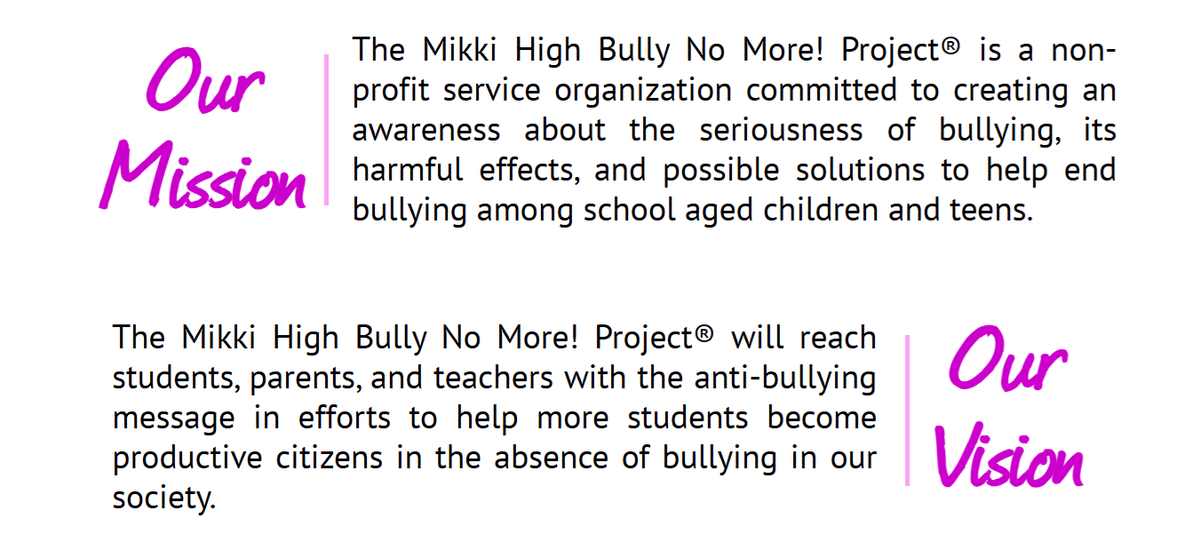
The mission of the Bully No More Project is to raise awareness about the seriousness of bullying and to equip people of all ages with the tools they need to stand against it. The project focuses on prevention, intervention, and empowerment. Through educational outreach, community engagement, and resource development, Bully No More works to create safe environments where individuals can thrive without fear of harassment or intimidation.
The project’s initiatives include school presentations, community workshops, and resource materials designed to help children, parents, educators, and leaders recognize and respond to bullying in constructive ways. By combining education with encouragement, Bully No More promotes understanding, builds confidence, and inspires resilience in those who have experienced bullying.
At its heart, the Bully No More Project is not just about ending negative behaviors but about fostering positive ones. It is about replacing fear with strength, isolation with community, and despair with hope. The vision is to see a generation rise above bullying and embrace their full potential in a supportive and respectful world.
About Our Founders
The Mikki High Bully No More! Project® was founded in 2011 by Dr. Tiffany “Mikki High” Hoffman and her father, Apostle Dr. Ludie L. Hoffman, with a shared vision of building a world where children and teens can grow up free from abuse, fear, and oppression. Born out of personal tragedy and triumph, their commitment to hope, awareness, and empowerment has touched countless lives and continues to expand through their leadership.
From the very beginning, one of the key ways the Hoffmans have carried this mission forward has been through books, resources, online media, and other educational tools that spread awareness beyond the stage. These materials, combined with partnerships from schools, churches, community organizations, and individuals, have allowed the project to multiply its reach and equip more people to take an active role in prevention. The support of partners has been essential in sustaining the momentum of the movement and creating lasting change.
As the national spokesperson, Dr. Tiffany “Mikki High” Hoffman uses her voice and platform as a recording artist, author, and motivational speaker to represent the project. Through concerts, rallies, movie nights, school tours, public speaking, and online outreach, she gives a voice to those who often feel silenced. Her message of hope and resilience continues to inspire students and adults alike to stand against bullying and build stronger, safer communities.
Guided by the wisdom and vision of Apostle Dr. Ludie L. Hoffman, the project has stayed rooted in its founding values of compassion, education, and empowerment. His leadership ensures the mission remains focused and far-reaching, while his daughter’s energy and voice bring that mission to life on the frontlines. Together, they model a powerful partnership that reflects the importance of family, faith, and unity in making a difference.
Through their shared leadership, The Mikki High Bully No More! Project® has become more than a campaign—it is a movement of hope and action. With the combined strength of dedicated partners, faithful supporters, and passionate advocates, the Hoffmans believe that we can create a future where bullying no longer defines or destroys lives, but instead, young people everywhere are free to thrive.
Join us in the movement to stomp out bullying and declare with us: 1-2-3-4 Bully No More!



© 2019